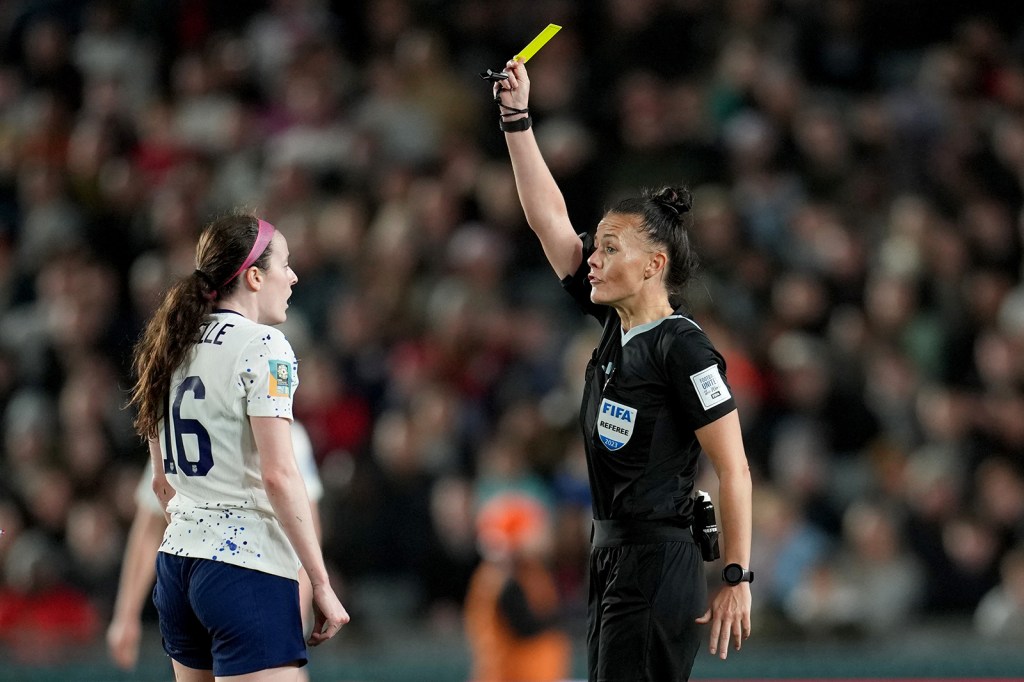
If you didn’t wake up in the middle of the night to watch the USWNT’s final group stage match against Portugal and simply looked up the score before your morning commute, it would be easy to dismiss their scoreless tie as a blip on the radar. After all, the tie meant the USWNT qualified for the knockout stage, keeping their perfect record of making it that far in the World Cup intact since the inaugural tournament in 1991. The USWNT has never finished less than third in the Women’s World Cup either, and they’ve come in to this year’s rendition in Australia and New Zealand hoping to complete the first-ever threepeat. With that hope still remaining, there’s plenty of reason for optimism…right?
Unfortunately, the context for this year is much less kinder for the USWNT. That scoreless tie featured the pitfalls that have plagued the team throughout this tournament: listless offensive play, zero visible structure in play, and easily diagnosed tactics. Despite the USWNT having plenty of shots, they were telegraphed near-perfectly by the Portuguese defense and goaltender Ines Pereira. Even worse, despite Portugal having no shots on target, one got through the defense and even beat goaltender Alyssa Naeher. The USWNT was a wrong bounce off the goalpost away from Ana Capeta becoming the team’s first-ever boogeywoman. To put it bluntly, it was the worst the USWNT has looked arguably in the tournament’s history, and a performance they were lucky to escape from with the qualifying point.
It isn’t the first time the USWNT has faced this type of adversity; they did sneak into the tournament in 2011 and finished second in their group. That team ended up pulling a shock run to the World Cup final before losing to Japan on penalties. This year, however, that ceiling doesn’t appear to exist. Therein lies the true essence of the problem: the USWNT this year simply isn’t that good, and there’s so many people and things to blame, you’d run out of fingers trying to point to them all.
The first problem is relatively easy to spot: USWNT manager Vlatko Andonovski and his tactical mismanagement. The same problems that plagued this team in the Tokyo Olympics in 2020 haven’t just come back with a vengeance; they’ve evolved into a singular maelstrom of catastrophe. Andonovski’s 4-3-3 structure has been painfully easy to diagnose and punish, and the play within it has been even worse. It was exposed horribly against Portugal, where they were able to overwhelm the USWNT’s midfield and force practically every single play to the left side, allowing the Portuguese to comfortably stay on one side of the field and kill offensive set after offensive set. By the time Andonovski finally switched back to the 4-2-3-1 to give the midfield some much-needed relief, it was far too late to do anything significant, and the USWNT remained on their back feet for the rest of the game. The lack of substitutions has also been an indictment of Andonovski, as he only made one substitution against the Netherlands, and only one was made before the final few minutes against Portugal. Speaking of the Portugal game, the choice of substitution was to take out Sophia Smith, the USWNT’s only decent attacker in this entire tournament. Andonovski did his best to defend his team’s lackadaisical effort against the critics, but the Portugal game was ninety-plus minutes of every concern being validated.
The players deserve some of the blame, as well. Defending has been good, even if Julie Ertz is being forced to play out of position due to poor structure. It’s also hard to put all of the blame on Naeher, even if it’s become clear that she’s the beneficiary of the good defending. The rest of the team in front of the five, though, has ranged from average to outright horrific. The midfield was exposed against the Portugal game, which is a combination of poor strategy and execution. Lindsey Horan may have scored the tying goal against the Netherlands, but it was followed up with a mediocre showing against Portugal. Andi Sullivan was victimized as the only defensive midfielder against Portugal, and Andonovski did nothing to help her until it was far too late. Rose Lavelle was their best midfielder throughout the tournament, and she won’t even be available for the Round of 16 due to yellow card accumulation. Becky Sauerbrunn is a good player and captain, sure, but was she truly that integral to the USWNT machine that the operation falls apart without her?
Despite all of this, nothing has been more indicative of the USWNT’s problems than their attacking play. Smith collected two goals against Vietnam and her metrics are somewhat better than her fellow forwards, but that latter point really isn’t saying much. The likes of Trinity Rodman and Lynn Williams have had moments, but they haven’t been immune to the team-wide inability to finish chances. The two biggest culprits, however, have been the USWNT’s most notable stars: Alex Morgan and Megan Rapinoe. Morgan hasn’t just struggled in this World Cup; she’s been an outright play killer. Andonovski’s strategy revolves around Morgan getting the final passes from one of the wings, but Morgan just doesn’t have the physical traits anymore to take advantage. Rapinoe has arguably been even worse. In the half hour she played against Portugal, the creativity that got her the Golden Ball award for best player in 2019 was nowhere to be found. Both are among the elder stateswomen of their team (Rapinoe is the oldest on the team at 38, while Morgan is 34,) and it appears that Father Time has claimed both of them.
The reward for barely squeaking in to the knockout rounds for the USWNT is a date with the winner of Group G. That team is expected to be Sweden, who only has to deal with a winless Argentina squad to lock up the spot. Let’s do a simple comparison: a USWNT that has put together three straight uninspired performances, each one less convincing than the last, and will now be without its best midfielder against a Swedish team that only struggled at the beginning of the tournament and is coming off a dominant 5-0 smackdown of Italy, not to mention one that defeated this same USWNT at the Olympics and could be fully rested? This feels less like a clash of the titans between two of the top three teams in the world, and more like that scene from Black Panther where T’Challa gets bodied by Killmonger. On paper, the USWNT could be booking their flight out of Oceania soon unless something drastic happens.
The sad part about all of this? There are plenty of Americans that seem to relish in the USWNT’s failure, mostly for reasons regarding differences in political values or being put off by what the public considers to be unchecked arrogance. Of course, this leads to the ideas of sexism and people hating on the USWNT’s success but, the more I look at the issues, the more those feel like convenient excuses to dismiss and deflect the criticism.
Perhaps the question to ask is one of introspection: why should Americans care about the USWNT succeeding or failing if it feels like they don’t even care themselves?
Former USWNT captain Carli Lloyd was incensed by her former teammates celebrating their undeserved advancement, and it hasn’t even been her first criticism of the team since her retirement. Despite all of her success with the team, Lloyd mentioned how the USWNT’s culture had grown toxic in their success, with players focused more on their own individual brands than coming together to represent their country. She isn’t the only other former player to take issue with the USWNT either: Hope Solo made an Instagram post decrying the team after claiming victory in the dispute over equal pay after taking a less-than-optimal deal. Of course, it’s also hard to not discuss the USWNT’s left-wing political leanings as a point of contention among Americans, with the outspoken Rapinoe as its poster child. My problem isn’t so much the USWNT’s politics; the right to free speech allows them to feel however they want, and I typically don’t bother about politics unless the system requires violence and/or forceful coercion against people to function. That said, when the statements off the pitch begin to feel louder than the ones being made on it, it’s hard to question the validity of Lloyd’s points.
So what happens if the expected result comes to pass and the USWNT finishes out of the podium for the first time? First off, Andonovski would almost certainly be out the door. He doesn’t have the pedigree of his predecessor Jill Ellis to protect him; she has the two World Cup wins, he only has an Olympic bronze medal and a potential World Cup faceplant. Whether Andonovski and his staff are the only firings or the beginning of an organization-wide purge is to be determined. Another thing that has to be considered is how the USWNT’s roster is built. Morgan, Rapinoe, Naeher, and defender Kelley O’Hara are all ages 34 and above, so this World Cup is likely their last. There’s plenty of young players that could step up, whether they’re already on the roster (Smith, Rodman, Naomi Girma, Ashley Sanchez, and Alyssa Thompson) or could take a spot on the squad in a few years’ time (Jaedyn Shaw, Sam Coffey, Mia Fishel, Taylor Kornieck, and Tierna Davidson). Of course, finding the next wave of USWNT stars could be difficult due to the talent pipeline having its own issues.
Coming up with a plan to save the USWNT isn’t easy, and it’s even harder to determine if change will actually be coming or if the failure will simply be blamed on injuries. Maybe some guy’s opinion on an internet sports blog doesn’t mean much to certain people, but if I didn’t at least care somewhat, I’d join the people laughing at the USWNT from the peanut gallery. So why am I being so cynical about the USWNT? Because I’ve seen this movie play out dozens of times before. A dynastic or potentially dynastic team straying from the course that made it possible to achieve their success, get stuck in their ways for no particularly good reason, and then ultimately collapse under the combined weight of arrogance and expectations. Like with the other examples, there’s a way to fix the USWNT’s systemic problems, but only if the USWNT is willing to acknowledge that such problems exist.
The only thing that awaits at the edge of the forest of decadence is the desert of despair, and the USWNT may be feeling the sands underneath their feet.

 The Sports Nerd Speaks